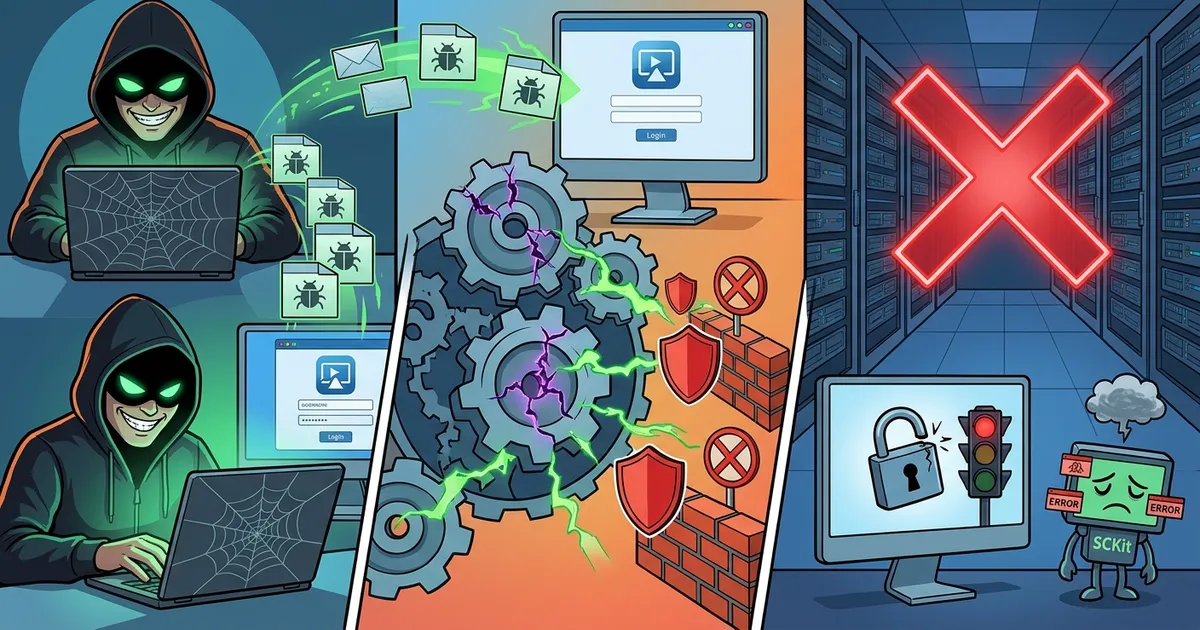
Rapid spread, but no successful exploit
Within the first ten minutes the campaign compromised about one‑third of the 288 endpoints it eventually hit across 48 organizations. All devices were taken over in under ninety minutes.
How the attackers got in
The entry point was the third‑party ScreenConnect extension RMM+ (versions 1.0.31 and 1.0.32). A flaw let the shared access key be left blank, so an attacker could supply an empty key and bypass authentication entirely.
What SCKit does
SCKit is a collection of 16 scripts that establish persistence on a compromised host and try to move laterally through other machines managed by ScreenConnect. One component, RelayTrap, is stored as a C# source file (RelayTrap.cs). The file is downloaded and compiled on the victim via PowerShell, then attempts to replace the legitimate ScreenConnect Guest process.
The replacement is meant to send a malicious payload back to the technician’s workstation and trigger CVE‑2026‑84869, a client‑side file‑transfer bug that ConnectWise patched in version 26.6.5.
What the research shows
- Huntress and Blackpoint Cyber saw no successful exploitation of CVE‑2026‑84869 in any of the recovered logs.
- Blackpoint’s testing against a patched ScreenConnect client failed to execute the exploit.
- Console‑takeover attempts recorded by Huntress were unsuccessful on every host examined.
Who is affected
Any managed‑service provider that runs ScreenConnect with the vulnerable RMM+ extension is in scope. ConnectWise responded by disabling five third‑party extensions across roughly 400 partner environments.
Defensive steps
- Upgrade ScreenConnect to version 26.6.5 or later – the patch closes CVE‑2026‑84869.
- Remove or update RMM+ extensions to a version that enforces a non‑blank access key.
- Rotate shared access keys immediately and enforce unique credentials per technician.
- Monitor for unknown PowerShell commands that download and compile C# source files.
- Alert on the creation of a process named “ScreenConnect Guest” that originates from an unexpected directory.
- Consider network segmentation that limits customer devices from reaching technician workstations.